
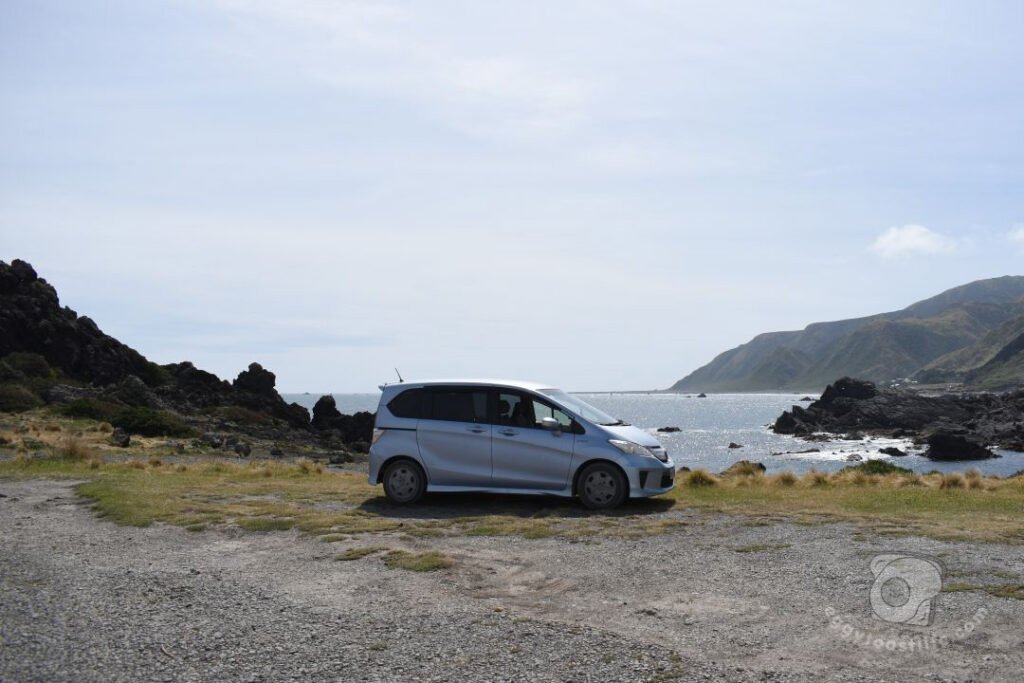
Buying a car is one of the biggest financial and logistical decisions you’ll make during your WHV. Especially if you’re looking to travel around New Zealand’s beautiful sights and sounds, finding a reliable car is imperative for your WHV journey since they will literally be your legs and for some, your home!
We weren’t knowledgeable about cars before going to New Zealand, and these are some important things we wished someone told us 🙂
Where to buy a car in New Zealand
You can either buy a car from a dealer or privately (buying directly from the car owner). Each has its own pros and cons, so it really depends on what you’re comfortable with
Buying from Used Car Dealerships
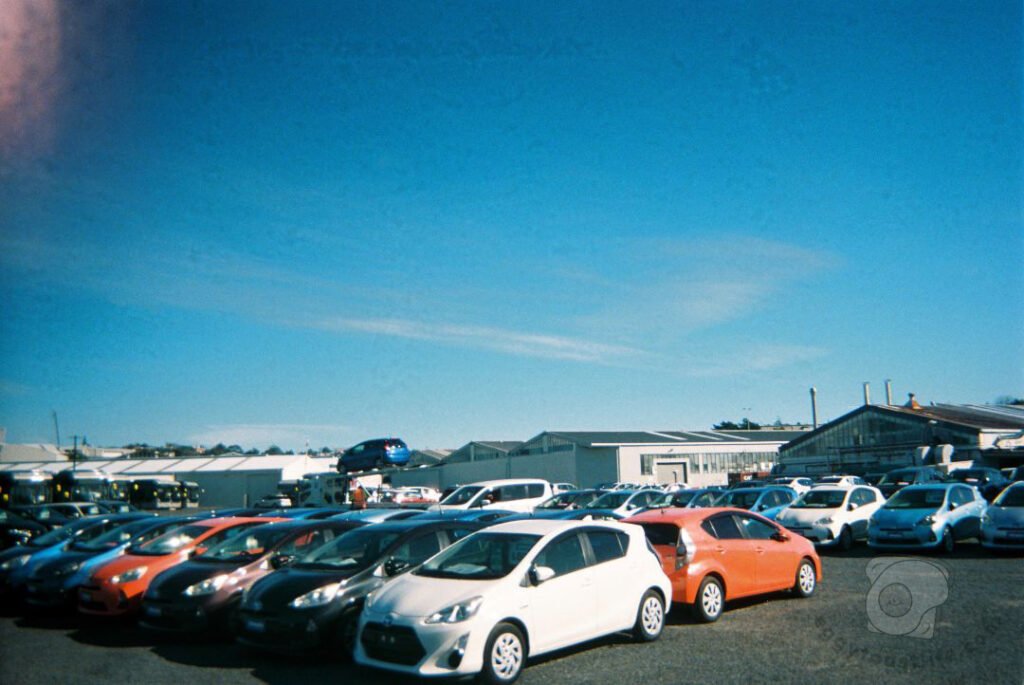
When buying from used car dealerships, there is a chance that you may be the first owner in NZ. Which means that it may be marginally more expensive as you’ll have to pay for the on-road costs (ORC) such as the REGO and WOF (terms that will be explained in the next section).
- Easier purchasing process.
- Usually more paperwork is provided.
- Greater consumer protection.
- Often more expensive.
- May offer warranties or financing.
Dealerships are a business so they operate with working hours which might be more convenient in some cases, compared to dealing with a private owner depending on when they are available. The car handover with a dealership is generally more straightforward as they would handle most of the paperwork, transfer of ownership and stuff for you.
Tip: dealerships often list their available cars on their websites/trademe so you can check if there is a model you like before heading down for a test drive.
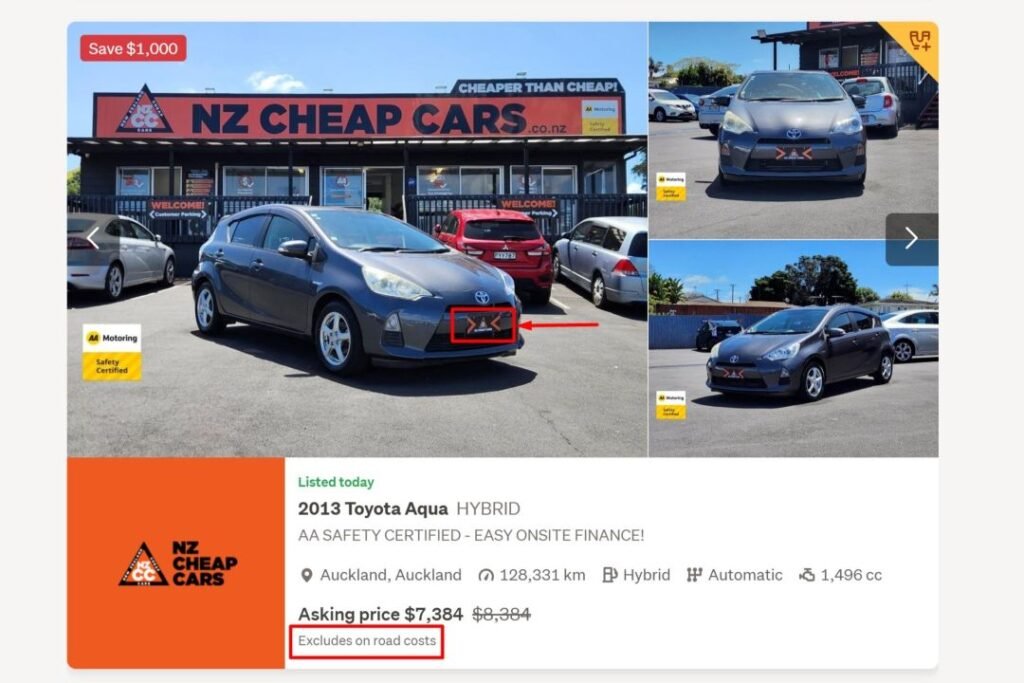
Example of dealer listing on Trademe:
(usually has company logo, excludes on road costs, car has no licence plate yet aka just imported to nz)
Buying Privately
This route involves dealing with the seller directly and buying the car from them. You’ll need to handle things more independently such as arranging handover, payment, transfer of ownership and renewing on-road costs if necessary. However, prices will usually be better than buying from a dealership.
Especially if you’re buying from other backpackers leaving the country, it may usually come with camping freebies etc that you might also need. Of course, the freebies shouldn’t be what decides what car you get, but it is an added benefit.
- Potentially cheaper deals, room for negotiation based on car condition.
- Good for finding campervans and backpacker cars.
- Easier to contact sellers directly.
Platforms to find Private Used Car Sellers
1. Trademe Motors – https://www.trademe.co.nz/a/motors
Trademe requires users to have an account to sell their car, and based on my research (when selling my own car), charges a fee for users to list their car. Based on that, most of the sellers there should be genuine since they paid to list their car.
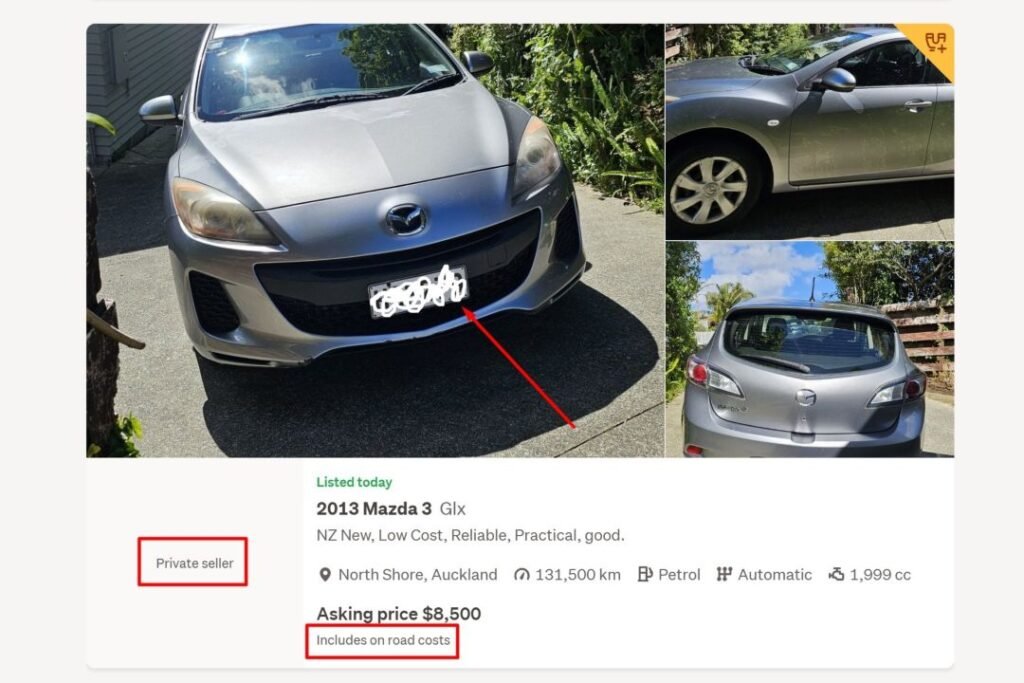
Example of private seller listing on Trademe:
2. Facebook Marketplace
Popular place to find other backpackers selling their car before leaving NZ especially camper cars and camper vans. As FB Marketplace is less regulated, there could potentially be scammers lurking.
Based on our experience buying and selling items on Facebook Marketplace while in New Zealand, most people are friendly and genuine sellers/buyers. But as with everything, there is always risk and we should always use our instincts. Making conversation with the seller during the test drive could help you understand why they are selling the car and what it was used for etc.
3. Facebook Groups
Kind of an overlap with FB Marketplace, but there are LOTS of groups you could join to help you find cars being sold in your area. Search for Cars Buy Sell in [your area] / backpacker / WHV groups.
These are just some examples:
Process for Buying Privately
1. Message seller to arrange a viewing
Viewings can be held at either the seller’s place or at a mutually agreed location. When we sold our car, we held it at a quiet carpark near our place.
For test drives, they might take a photo of your licence or the seller may sit with you to explain features and functions of the car.
2. Negotiate based on the car’s condition, maintenance history, tyres, WoF and any repairs required.
More info on what to look out for during a viewing in the next section.
Optional: If you want greater peace of mind, you can opt to arrange for a pre-purchase inspection (PPI) to have a mechanic inspect the car before you purchase. But this would be at your own cost, even if you don’t end up purchasing the car.
3. Agree on payment and handover date
In some cases, the car may not be ready to be driven off immediately as the seller might still be using it. It should usually be stated in their listing 🙂 but if not, it’s good to find out before going for a test drive.
For payment options, it’s usually either by bank transfer or cash. It’s important to know that in NZ, bank transfer is not immediate between 2 different banks (e.g. ANZ to BNZ) and may take up to an hour to appear. So if you and the seller are with different banks, you might have to wait around before the funds appear.
When we sold our car, it took about 45minutes or so for it to clear and we just sat in the car and chatted with the buyer. But you could def go have coffee etc and meet again, it’s chill.
4. Transfer the registered-person details on NZTA
Both buyer and seller must notify NZTA immediately. The buyer completes the buyer notification and the seller completes the seller notification.
When purchasing as a backpacker without a New Zealand driver licence, you’ll need to visit an NZTA agent. So it might be good to arrange the handover nearby an NZTA agent (NZ post, AA, VINZ, VTNZ etc).
You can find your nearest NZTA agent and more info about Transfer of Ownership here: https://www.nzta.govt.nz/vehicles/buying-or-selling-a-vehicle/buying-a-vehicle
If the seller has a New Zealand driver licence, they will be able to complete their section online.
An important thing to know is that in NZ, being the registered person is not exactly the same as legal ownership. Keep your purchase agreement and payment evidence.
The NZTA transfer of ownership just ensures that the toll fees/fines etc will now be charged to you.
Private vs Dealership
|
Private seller |
Dealer |
|
|
Price |
Often cheaper |
Often higher |
|
Negotiation |
Usually easier |
Varies |
|
Vehicle history |
Depends on seller |
More formal disclosure |
|
Consumer Guarantees Act |
Generally doesn’t apply |
Applies |
|
Fair Trading Act |
Generally doesn’t apply |
Applies |
|
Consumer Information Notice |
Not required |
Required |
|
Mechanical inspection |
Arrange yourself |
Arrange yourself |
A dealer must comply with the Consumer Guarantees Act and Fair Trading Act. Private sales generally offer fewer protections.
When we arrived in NZ, we weren’t very familiar with cars and for peace of mind purchased via a dealership. But through the process of selling our car on FB Marketplace privately, I think that you definitely can get a better deal buying directly from sellers. Just be sure to do your research, understand what to look out for and exercise your own instincts and gut feeling when doing a test drive.
NZ also has a very strong second hand culture where people sell things that are in good condition, not things that they don’t want. That’s not to say everyone is 100% honest and perfect, but it’s not all scammers out there selling their cars!
Important Things to Know About NZ Vehicles
There are key things you need to know about owning a vehicle in NZ, and these are important to know about in your buying process as well as during your time owning the car.
Both WoF and REGO can be found stuck on the windscreen of the vehicle.
WoF – Warrant of Fitness
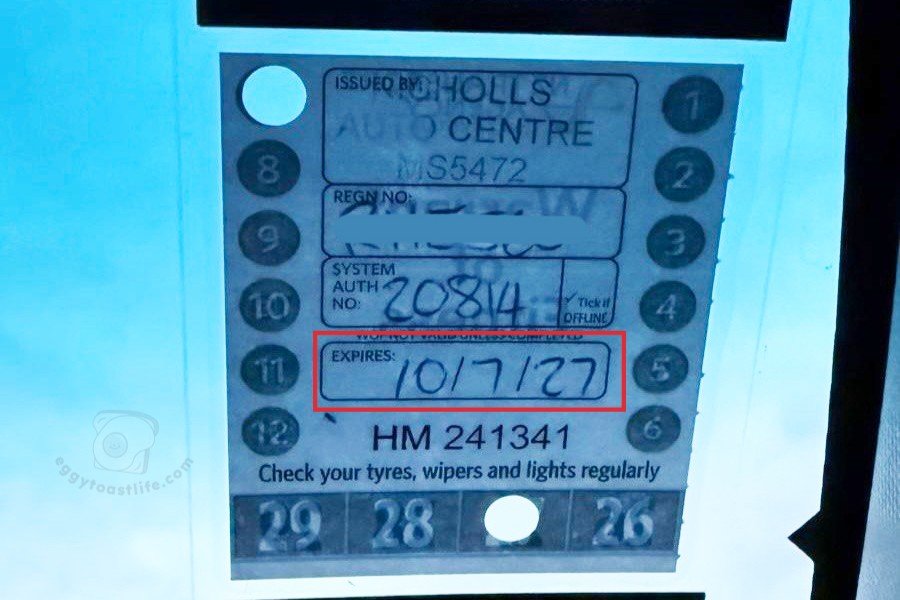
A WoF is a periodic vehicle safety inspection.
It checks things such as:
- Tyres.
- Brakes.
- Lights.
- Steering and suspension.
- Seatbelts.
- Windscreen and wipers.
A valid WoF does NOT mean the vehicle is mechanically reliable.
For example, a vehicle can have a valid WoF but still have other mechanical issues like a deteriorating clutch.
How often is a WoF required?
For most vehicles first registered anywhere in the world on or after 1 January 2000 generally require an annual WoF.
Ideally you want to look for a car with a recent WoF issued because it means that it was checked recently and you won’t need to do it for a while.
You can find out more about WOF from the NZTA website.
REGO – Vehicle licensing
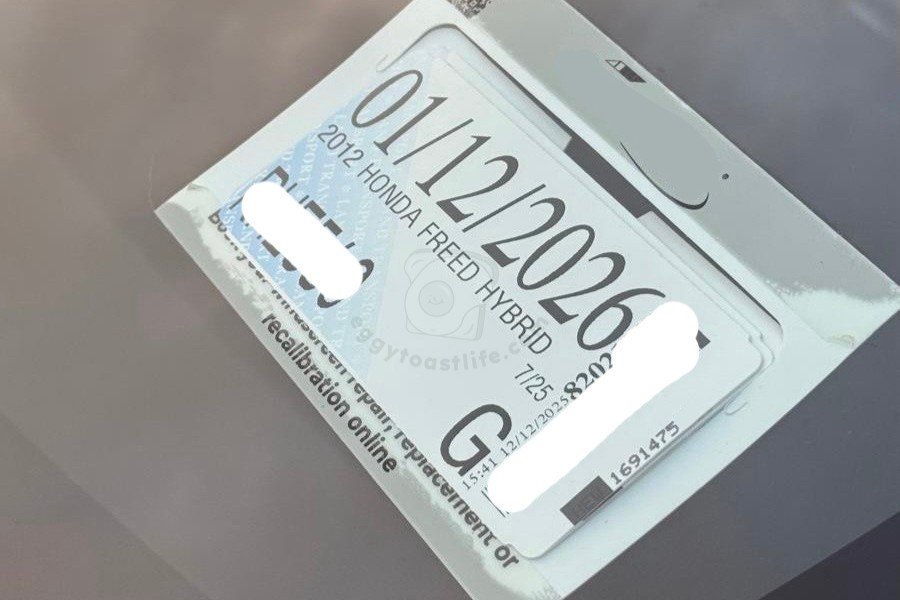
Rego is the periodic vehicle licensing fee.
It allows the vehicle to remain licensed for road use and includes an ACC levy.
Common licensing periods are six or twelve months.
When you look at a car listing, you might see:
– WoF: June 2027
– Rego: February 2027
This means the car has a current safety inspection until June and a current vehicle licence until February.
You can renew the rego when required at NZ post to get the new REGO immediately. Or if you have a stable address, you can do it online and they will send the new REGO to your address.
Things to Know & Look Out For
I’m no mechanic and no expert in cars. But these are some useful starting points to look out for when you buy a car.
Vehicle History
Before buying a car, you can check the car’s vehicle history with the car plate on https://www.carjam.co.nz/
Example:
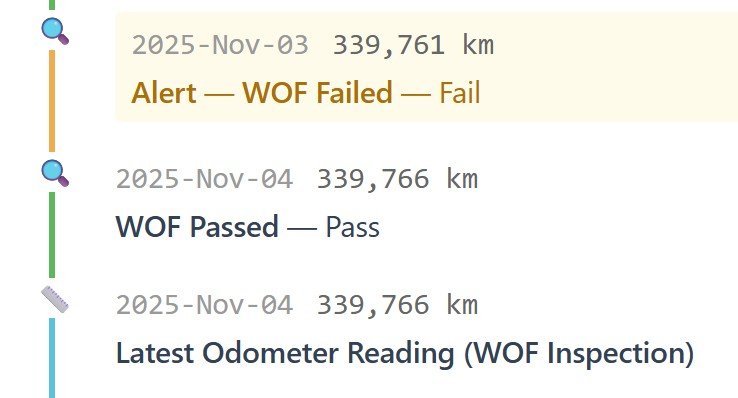
You can check whether a car has failed its WoF in the past, when it was imported to New Zealand, whether it is a stolen car, its recorded mileage from previous WoF to see if the car’s odometer had been reset before and more.
Failing a WoF in the past is not necessarily a bad thing as it’s usually fixed right after that. It’s a good opportunity to find out more and ask about what caused it to fail and what fix was done.
For example, a vehicle could have failed its WoF in the past due to worn out tyres and so it had new tyres fitted recently. In this case, it would mean the vehicle should have tyres with good tread depth, something you can check during your viewing 🙂 This information can help you to gauge the value of the car better.
Mileage
A lower mileage is always preferable especially when you are going to be selling the car again when you leave New Zealand. However, the condition of a car is usually more important than the mileage itself.
For context, after 1 year and 3 months travelling across New Zealand from North Island to South Island, we added ~25,000kms to our car’s odometer. We did quite a lot of road trips and travelling between cities / towns so depending on your travelling style you could roughly gauge how much more mileage you will add if it’s helpful.
Car Condition
Test Drive:
- Check the dashboard for warning lights.
- Test the air conditioning and heating.
- Does the engine start easily?
- Does the car accelerate smoothly?
- Does the steering pull to one side?
- Does the transmission shift smoothly?
- Are there unusual vibrations or sounds?
- Do the brakes work smoothly? Try braking abruptly in a safe manner (e.g. quiet carpark)
Viewing checks:
- Check engine oil (there are videos on YouTube that show what to look out for)
- Look for uneven paintwork or signs of accident repairs.
- Check the condition of tyres. Good tread depth and no uneven wear.
- Check that all doors open and close properly.
- If the car is a hybrid, ask about hybrid battery condition and history
Car Interior & Aesthetics
- Check whether the seatbelts work.
- Be aware of any external paint scuffs, scratches etc on the car body and tyre rims
- Look at the condition of the seats and carpets.
These are mainly cosmetic but while we were selling our car, we found that many buyers nitpicked appearance things like small scratches to bump the price down. So just something to consider as it will affect the price you sell your car at in future too.
As we were not confident and wanted peace of mind, we did pay for a pre-purchase inspection before we purchased our car! I do think in most cases it should be fine without a PPI, but it’s a personal choice on whether it’s a risk you want to take.

What type of vehicle should you buy?
Whether you get a small car or a large 6-seater is all dependent on your lifestyle and driving confidence. The best car for a WHV traveller depends much more on your travel and working style than on the car itself.
Someone spending six months working in Queenstown has very different needs from someone travelling around both islands, moving between orchards and packhouses, or living out of their vehicle.
1. Small hatchback
Best budget option, suitable for solo travellers, easy to drive and move around cities/towns. A good choice if you’re mainly looking to base yourself in a city/town and travel around to places.
Examples: Toyota Vitz/Yaris, Honda Fit/Jazz, Mazda Demio.
- Easy to drive and park.
- Usually economical on fuel.
- Cheaper tyres and maintenance.
- Suitable for two people with manageable luggage.
- Limited sleeping and storage space.
2. Station wagon
Best all-rounder, suitable for solo travellers wanting to sleep in car or couples (more luggage space)
Examples: Toyota Corolla Fielder, Subaru Legacy wagon, Honda Airwave.
- Much more luggage space.
- Good for couples and seasonal workers.
- Can fit a mattress for occasional sleeping, depending on model and layout.
- More practical for longer road trips.
- Usually slightly more fuel consumption than a small hatchback.
3. SUV / crossover
Examples: Honda CR-V, Toyota RAV4, Nissan X-Trail.
- More ground clearance in some models.
- Good luggage capacity.
- Comfortable for long journeys.
- Some AWD models offer extra traction.
- Higher fuel and tyre costs are possible.
4. Campervan / converted van
Examples: Toyota Hiace, Nissan Caravan, Mitsubishi Delica.
- Sleeping and storage space.
- Potential savings on accommodation.
- Can carry cooking equipment and camping supplies.
- More expensive to purchase and maintain.
- Larger vehicles consume more fuel and can be harder to drive.
5. People mover / minivan
Examples: Toyota Estima, Honda Odyssey, Nissan Serena.
- Good for two to four travellers.
- Flexible seating and storage.
- Can be adapted for sleeping.
- More complicated mechanical systems in some older models.
- Fuel consumption can be relatively high.
Our Experience and Thoughts
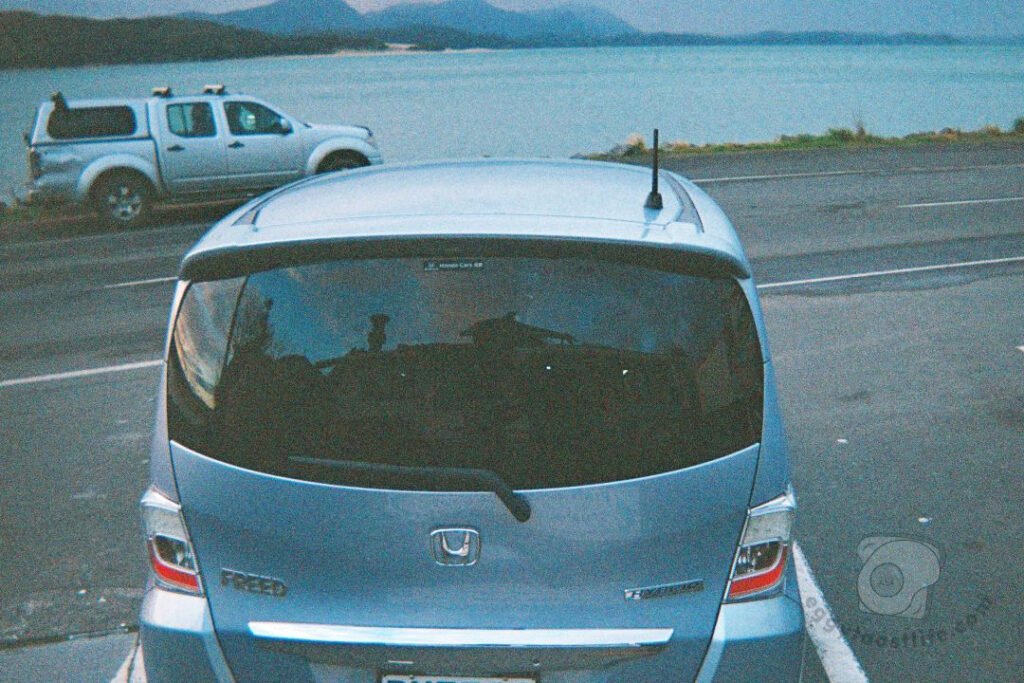
We got a hybrid 6-seater 2WD for 2 of us as we were undecided on whether we wanted to sleep in the car or not. Our car was a 2012 Honda Freed that was bigger than a regular car but on the smaller side compared to camper cars like Nissan Serena.
In the end, we didn’t convert our car into a camper as the seats couldn’t fold flat and we didn’t want to remove the seats since we were hoping to sell our car eventually.
For 2 people with a main focus of travelling NZ, WWOOFing + occasional working, we were happy with our car as it allowed us the luxury of space for all our luggage + camping gear!
4WD or 2WD
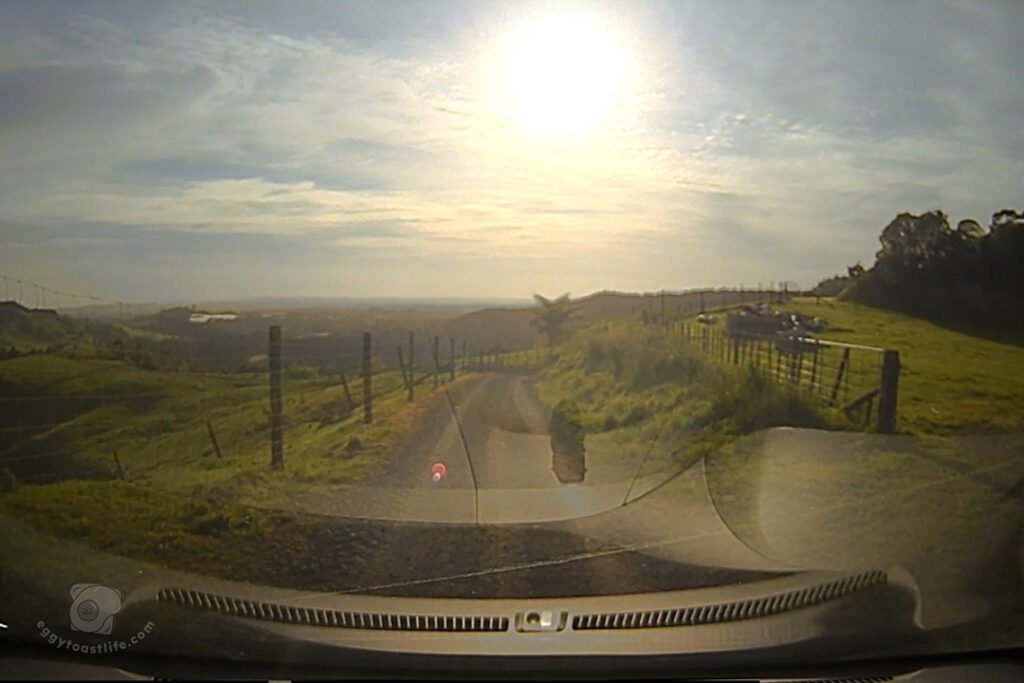
In hindsight, we do wish we got a 4WD as our car had a very low clearance. In places with ford crossings (e.g. Wanaka-Mt Aspiring road up to Raspberry Flats Carpark to Rob Roy Glacier), we didn’t want to risk our car getting stuck and had to hitchhike to get there. So having a 4WD would have definitely allowed us to go to a few more places more independently. While we worked our kiwi job, some orchards were located on hilly gravel roads (pic abov) and we almost got stuck once.
But some kind backpackers who also almost got stuck before us, pulled over to help the rest of us leave 🙂
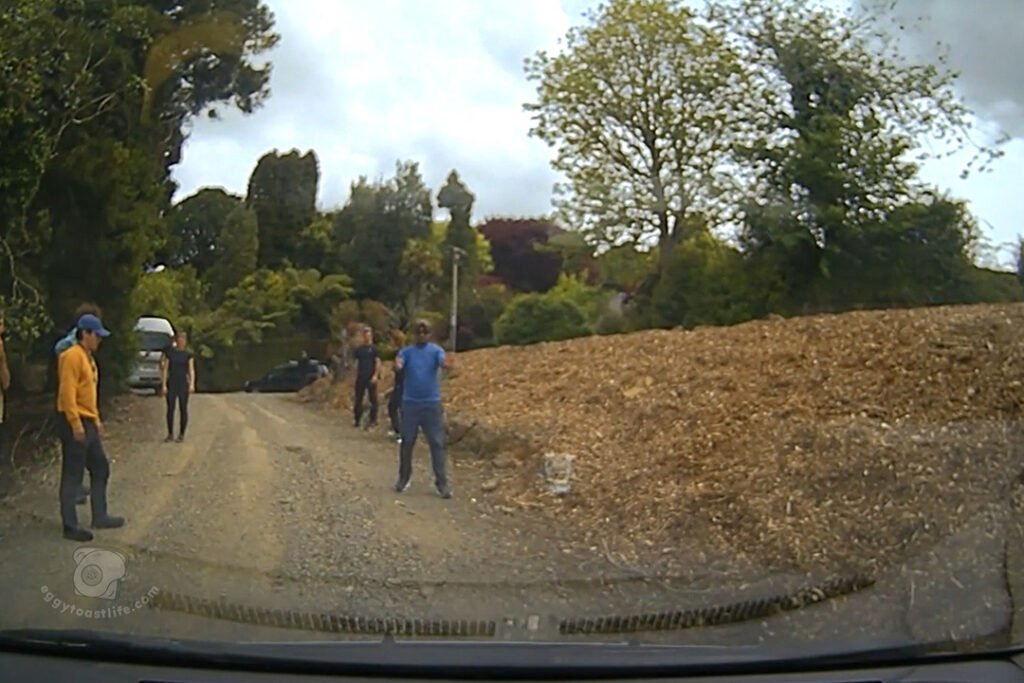
Aside from these two instances, we got around to most places and even drove on most gravel roads in NZ perfectly fine with our 2WD. I just think 4WD is a nice added benefit of having a stable, smoother drive since we did go to many places with gravel roads.
If you’re a super adventurous person and confident driver, having a 4WD might suit your WHV lifestyle better. In most cases, I think a 2WD is sufficient as most main roads are paved / manageable gravel.
Hope this was helpful in your NZ WHV journey, happy car shopping 🙂